
He has told you, O mortal, what is good,
and what does the Lord require of you
but to do justice and to love kindness
and to walk humbly with your God?
Micah 6:8
In the Bible, justice is to “make right”. It is a relational term of living in right relationships with God, with one another and with Creation. Biblical justice is not separate from social justice. Throughout the Bible, God’s people are called to care for who is seen as the least in society. We are called to love our neighbour as ourself. We are called to see people as God sees them - created in God’s image.
As a Church who prays weekly “Thy will be done on earth as in heaven”, we have a responsibility to care for others and seek justice. We recognize that at times it is the structures within society and government policy that have resulted in unfairness or difficult circumstances for people. We undertake activities that seek to redress that injustice.
Make Your Values Known - Provincial Budget Consultation
“Then the king will answer them, ‘I’m telling you the truth: when you did it to one of the least significant of my brothers and sisters here, you did it to me.’ Matthew 25:40
Governing is about making choices. The Nova Scotia government has begun a budget consultation to understand what matters most to Nova Scotians to help shape their spending decisions. As Christians we are called to care for the people on the margins; this is our opportunity to share with the government that marginalized people matter. A two page backgrounder on concerns and the consultation was prepared for the congregation which you can see by clicking here. The information presented below contains additional information so that there is a fuller understanding of the issues of homelessness and income assistance. You can link to the budget consultation here or at the end of the article.
You can see the letter that Grace sent by clicking here.
Homelessness
When people do not have permanent, safe and appropriate housing they are considered homeless. It ranges from people who are unsheltered homeless, living outside or in cars, to the sheltered homeless; people living in housing or transition shelters, couch surfing to in hospital and correction institutions who have no fixed address.
Homelessness has grown in Halifax for several years. Both homeless measures (Point-in-time Count that covers a 24-hour period and a By-the-Name data which is a list used by agencies to help people find shelter) have shown growth.
Homelessness measured by the Point in Time (PIT) Count counted 1,150 people as homeless in HRM (urban sections – Halifax, Dartmouth, Bedford and Lower Sackville) on the evening of October 15, 2025 to the early morning of October 16. Of these people, 17% (197) of the homeless were unsheltered, the majority (121) of those unsheltered were encampments. Of the 83% being sheltered; 726 people were in shelters; 90 in shelter diversion hotel programs; 64 in domestic violence transition houses; and within institutions there were 51 people in hospitals and 52 in corrections who had no fixed address.
The number of homeless increased from 586 in 2022 to 1,132 in 2024 to 1,150 in 2025. The “couch surfing” type of homelessness was not captured in the 2025 PIT report.
The dynamic nature of homelessness is captured by the real-time By The Name List which is a list of every person experiencing homelessness and is used to coordinate services. In the weekly HRM Homelessness Snapshot (By-the-Name list) for September 9, 2026, there were 2,082 individuals and families currently experiencing homelessness. Of that number, 885 individuals and families have been homeless for at least 6 months of the last 12. The By-the-Name list for September 10, 2025 showed 1,028 individuals/families as being homeless.
These reports can be found in the Affordable Housing of Nova Scotia’s website: https://www.ahans.ca/statistics although the weekly update may have changed.
The Halifax Examiner reported that in a meeting of HRM’s accessibility advisory Committee, that Max Chauvin, HRM’s director of housing and homelessness, gave a presentation on the 2024 Point in Time count from October 20, 2024. Chauvin used growth models to calculate a forecast of homelessness in the municipality based on the status of the Canadian economy. “He said if the news on the economy is good, homelessness in Halifax will grow from 1,132 to about 1,800 people. But if the economy falters, there will be more than 4,000 people homeless in the next decade.”[1]
Homelessness comes at high cost to the individual and to society.
Chronic homelessness is linked to serious health issues, frequent use of emergency services, increased exposure to violence, and social and economic exclusion. For example, a 2024 Ontario-based research project found that individuals experiencing homelessness incurred an average of $12,209 in annual public health care costs, compared to $1,769 for housed individuals. Even after adjusting for mental health, substance use, and other comorbidities, healthcare costs remained six times higher for those who were unhoused.[2]
Governments have had some success in moving people from unsheltered to sheltered homelessness. Although generally an improvement, it is not ideal – it lacks the permanency required and shelters that operate only on a nightly basis or have multiple people in rooms lack the feeling of security and safety that people need. People need to have stable housing for a foundation for recovery and stability. Furthermore, temporary shelter costs tend to be higher than supportive housing.[3] The Housing First approach has been found to be successful. It aims to quickly move individuals experiencing homelessness/housing instability into permanent housing and then provide wrap around supports.
Why are People homeless?
According to the detailed survey in the 2024 Point in Time Count, the top reason why people are homeless is not enough income (39% of respondents). When various family conflict/relationship breakdown issues were grouped together it was the reason why 32% were homeless. Unfit or unsafe housing conditions was 12%; while 10% cited substance abuse and 8%, mental health issues. Ability to afford housing would also play a role in why people were homeless after relationship/family breakdown.
Income and Affordability
The shelter to cost ration of 30% of pre-tax income being spent on rent, electricity, heat and water is the generally accepted measure of affordability.
The CMHC October 2025 Rental Market Survey indicates that for Halifax the median monthly rent[4] was:
· $1,425 for a studio apartment (requiring a gross monthly income of $4,750 if all utilities were included)
· $1,595 for a one-bedroom apartment (requiring a gross monthly income of $5,317 if all utilities were included)
· $1,800 for a two-bedroom apartment (requiring a gross monthly income of $6,000 if all utilities were included)
· $2,200 for a three bedroom or larger apartment (requiring a gross monthly income of $7,333 if all utilities were included).
In the unlikely event that rent covered all the utilities and electricity, the number in brackets indicates the required monthly gross income required to be at the 30% cost ratio. If rent did not cover utilities, etc. more income would be needed.
Sources of Income
Employment: On April 1, 2026, the minimum wage increased $0.25 to $16.75 (gross weekly earnings $670 for a 40 hour week) while on October 1, 2026, the minimum wage will once again increase to $17.00 (weekly earnings $680). Most months would be a four-pay month which would mean a monthly income of $2,680 now or $2,720 in October. If two individuals were working forty-hour weeks, it would be $5,360 now and $5,440 in November. If a person worked 40 hours a week a hourly income of $29.69 would be needed for a four-pay month to meet the affordability criteria of a studio apartment.
OLd Age Security/Guaranteed Income Supplement: As of September 2025, the Old Age Security pension for ages 65-75 is $751.97 monthly, if over 75, it is $827.17. If the individual had no or very little additional income, the monthly Guaranteed Income Supplement (GIS) would be an additional $1,123.17 which would be a monthly income of $1,875.14 if you were between 65 and 74.
Income Assistance: As the table further in this provided information shows if one was on income assistance, the monthly income would not meet the affordability criteria in the private market.
For individuals who rely on income assistance, minimum wage or Old Age Security and GIS, the monthly income is still below the 30% ratio for all units.
Halifax has experienced growth in new rental buildings but these buildings tend to rent at higher rates. There was some speculation that the increased supply would cause movement in units, possibly freeing up lower price units or resulting in lower rents. Rental rates continue to grow as landlords maximize allowable rent caps and widen the gap paid by new and existing tenants. “On average, rent paid for a 2-bedroom unit was repriced 23% higher when a new tenant took over the lease on a vacated unit (turnover unit), compared to 4% for sitting tenants (non-turnover units). [5]
Deeply Affordable Housing
Deeply Affordable Housing, public housing, non-market housing or rent-geared to income housing is needed for people with low income so they are able to have income to meet their other needs. These housing units generally are not built by the private sector but by government, the non-profit sector or some combination. In the early to mid-1990s federal government began pulling back from affordable housing. This had an impact on the Province of Nova Scotia as they did not build any public housing units in over 20 years.
As of June 27, 2025 there were 8,267 applicants in Nova Scotia on the waiting list for public housing with the Nova Scotia Provincial Housing Agency, 3,545 of those were in Metro Halifax. In Metro Halifax 41% of the applicants were for one-bedroom units; 47% of the waitlist were seniors (the Nova Scotia Provincial Housing Agency considers anyone 58 years or older a senior). The wait list increased by more than 1,200 since October 2024. Nova Scotia has approximately 11,000 public housing units.[6]
Government committed to build 515 new public housing units in the Province over five years. Of the 515 units, 35 were built as of January 2026 and another 60 were expected to be ready in 2026. In a September 2026 update, government indicated that 307 units are complete or underway as of June 30, 2026. Non-profits or charitable organizations with some government support are an important part of the solution to provide deeply affordable housing.
More deeply affordable units need to be built/made available
The Government has made a commitment and needs to build at a faster rate but non-profits play a role in this sector and if government can assist it would be effective. Adsum for Women and Children made the following suggestions to government in the submission for planning for the 2026-27 provincial budget:
· Support acquisition of existing stock before it is lost of private developers
· Fund new builds by filling financial gaps that the private sector alone cannot cover.
· Assist maintenance and retrofits so existing non-profit housing remains safe, efficient and affordable
· Provide operating grants that allow non-profits to keep rent gears to income while covering the true cost of ownership, management, and wrap around supports.
Footnotes for Homeless Section
[1] https://www.halifaxexaminer.ca/government/city-hall/number-of-people-sleeping-rough-in-halifax-down-but-warning-about-homelessness-still-dire/
[2] Affordable Housing Association of Nova Scotia, Destination Home: Plan to Prevent and End Chronic Homelessness in the Halifax Regional Municipality, p. 28-29 found at https://c70215ca-44fe-456d-b395-e65a2c4e3f9a.filesusr.com/ugd/738778_bc72d2c9c98548c9921d97af1934410d.pdf
[3] https://8df723ea-da64-4e44-9f91-63251380a690.filesusr.com/ugd/738778_b3673a70ab0e4d7891d5069292189802.pdf
[4] https://www03.cmhc-schl.gc.ca/hmip-pimh/en/TableMapChart/Table?TableId=2.1.23.2&GeographyId=12&GeographyTypeId=2&DisplayAs=Table&GeograghyName=Nova%20Scotia#3%20Bedroom%20
[5]See https://www.cmhc-schl.gc.ca/professionals/housing-markets-data-and-research/market-reports/rental-market-reports-major-centres
[6] https://www.cbc.ca/news/canada/nova-scotia/housing-renters-cost-of-living-public-housing-1.7624336
Employment Support and Income Assistance Program
Basic needs assistance, the major part of the employment support and income assistance program is expected to cover needs such as food, clothing, shelter, fuel, utilities and other personal needs. This assistance does not cover all the necessities, particularly if the individual or family is renting in the private market. The chart shows the standard household rate for people who own or rent their own house or board, as well as the enhanced rate for single individuals who have a disability, conditions that limit employment, age 55 or older, are 16-18 inclusive or fleeing an abusive situation. People who are unsheltered, without a fixed address, in a homeless shelter or a transition house, hospital or rehabilitation program qualify for the essential rate of $410 monthly.
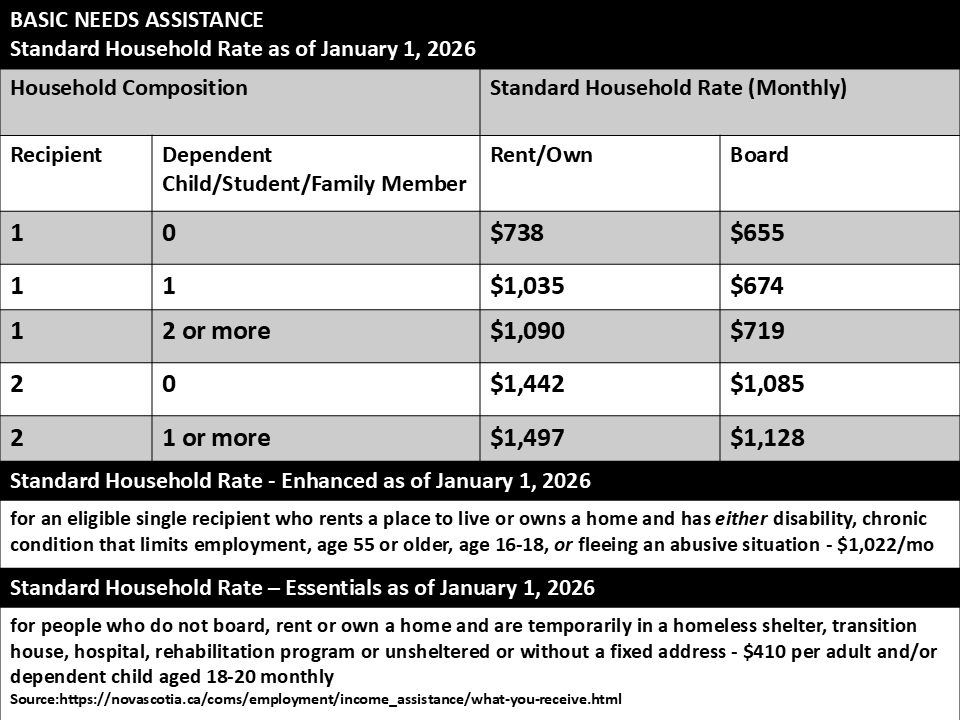
In August 2026, the government lost the court case to pay an enhanced standard rate to a disabled homeless person living in a tent as the court considered a tent, accommodation. Shortly thereafter, the government changed the regulations to ensure people living in tents no longer qualify.
In 2025, the government promised to increase all rates annually by the rate of inflation. The 2026 increase was 1.6% (based on yearly inflation rate as of April 2025). Between April 1 and December 31, 2025, the inflation rate increased an additional 1.3%. This compounded the loss suffered under the Houston government’s first mandate, when inflation increased 13.3% before there was a rate increase of 2.5% for April 1, 2024.
In 2023/24 the provincial government revamped the foster care system, changing it to a single block funding to cover expenses for the foster caregiver and child to be “more reflective of the costs of living and raising a child in Nova Scotia”. For a child in care without specialized needs, the bi-weekly payment was $1,493 in 2023/24 (translates into $106,64/day) and it was to increase annually by CPI. In 2026, the monthly payment for a single parent with one child was $1,035, (for a 30-day month it would be $34.50/daily). The foster parent would receive 3 times the amount the parent would receive to meet the needs of the parent and the child. (see slides 20 and 21, https://fosterfamilies.ns.ca/wp-content/uploads/2023/07/Redesign-Information-Session-Presentation-2023-May-FCGs-002.pdf)
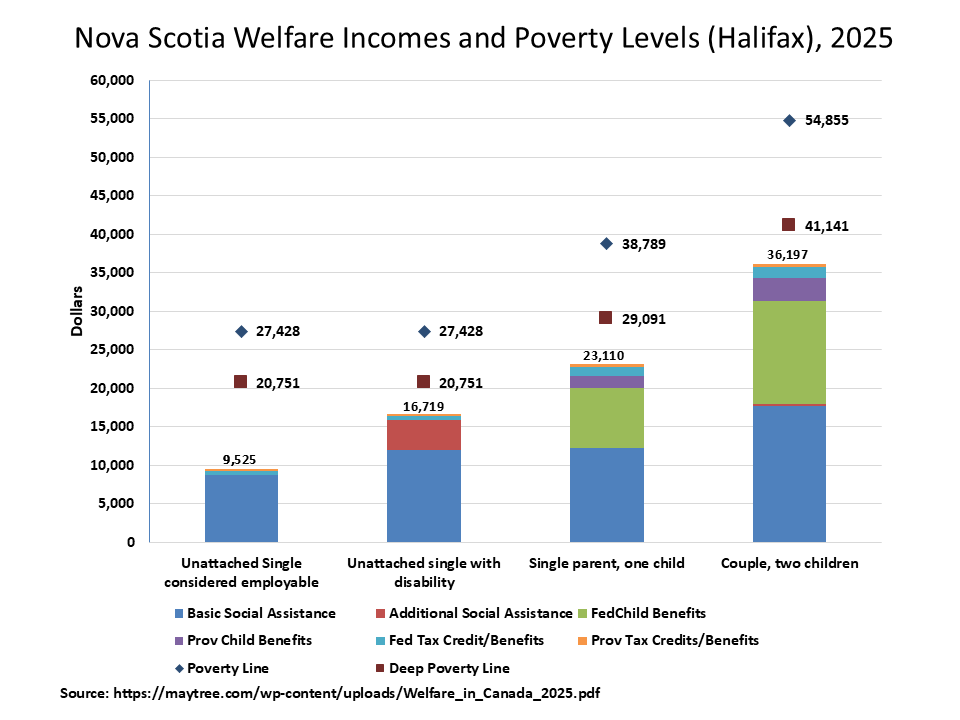
The chart below is derived from data in The Maytree Foundation’s Welfare in Canada Study, 2005, which was published in July 2026. Households receiving basic needs assistance have incomes supplemented by other federal and provincial government programming such as the GST credit, the Canada and Nova Scotia Child Benefit. In the chart below, the total income is known as welfare income. For single individuals, basic needs assistance forms most of their income. The federal child benefits have a substantial impact on the income of a family. The Maytree Study used the official poverty line which is Statistics Canada’s calculated market basket measures (MBM), which have a geographic component and are adjusted by household size. The study used the poverty line measures for Halifax.
However, the combination of these programs does not lift people out of poverty. Indeed, a study by the Mayfair Foundation indicated that the four representative households live in deep poverty (income is less than 75% of the official poverty line. Maytree’s methodology methodology did not include the Nova Scotia Poverty Reduction Tax Credit ($500 annually) as it was assumed that the households did not receive income assistance in the previous year. This tax credit benefit eligibility includes receiving income assistance from January-December of the previous year and having no children in the previous year and only one individual in a single or two-person household can receive it. In this example, even if both individuals received this tax credit they would have remained in deep poverty.
What can I do?
Provide feedback to the government that spending needs to be increased in the budget areas of Employment Support and Income Assistance Program under the Opportunities and Social Development Department and Public Housing and Housing under the Growth and Development Department to help protect the vulnerable. Be very explicit about your priorities to protect and enhance the lives of vulnerable people such as those without permanent housing and/or on income assistance. Government has been relying on church-supported services/organizations such as food banks to make up the gaps between their funding and what people need to survive. The Hunger Counts 2025 Report showed that for Nova Scotia, 29.3% of clients at the food bank, their primary source of income was social (income) assistance and that another 10.3% were on disability-related support.
There are 4 ways to provide feedback: in-person (Monday, Oct. 5 – Halifax Forum); virtual sessions (Sept. 23 (French), Oct. 2, and Oct. 6); build your own budget (online interactive tool); or to write (e-mail or letter). Pre-registration (at least 72 hours before) is required for in-person or online sessions. Further details are available at YourBudget.NovaScotia.ca.
Observations
Nova Scotia’s fiscal situation is serious. With an operating deficit ($1.24 billion this year’s budget) and a capital program that goes directly to the debt, interest rate costs ($1.03 billion or 1 of every 18 dollars spent in the operating budget) will only increase. In the background information, government has removed the option of increasing taxes or fees, leaving only economic development for revenue growth and expenditure cutting to slow in growth in Nova Scotia’s net debt of $28 billion. At the time of implementation, the 1% HST reduction was estimated to reduce provincial revenues by $265.5 million in 2026-27. Consultations apply only to the operating budget. People are encouraged to state their priorities and in the online budget adjust budgets for the departments and then for the major categories of departmental expenditures.
Difficult choices will have to be made and it is the time to let government know our values and ensure we protect the most vulnerable in society.
Previous Social Justice Actions/Campaigns
Dental Healthcare, Mental Healthcare, and Self Care
On May 27, 2025, at 7:00 p.m, Grace hosted a free public viewing of Anna Quon’s documentary, ‘Me and My Teeth’ followed by a fireside chat between Reverend Stephen Fram and Anna Quon. Anna is a Nova Scotia filmmaker, novelist, poet, writing workshop facilitator, mental health advocate, and at the time was Halifax Poet Laureate. This documentary and conversation explored social justice, empathy and respect, as part of one’s journey with dental care as part of our overall healthcare. Information about the Canadian Dental Care Plan, the Dental Benefits Guide for First Nations and Inuit: Non-Insured Health Benefits program and the Nova Scotia Basic Dental Care for Children 14 and Younger Plan was shared through this event.
Income Assistance and Housing
In early January 2025, Grace launched its “Poverty is a Policy Choice” campaign highlighting the Nova Scotia’s Employment Support and Income Assistance program (ESIA) for people who are unable to support themselves or their family. Basic needs assistance is supposed to cover needs such as food, clothing, shelter, fuel, utilities and other personal needs. This assistance does not cover all the necessities, particular if the individual or family is renting in the private market.
Prior to the 2024 provincial budget Grace had written to the Premier and government ministers to urge that these rates be increased and in 2025 Grace wrote to the Minister of Opportunities and Social Development (formerly Community Services) as even with a modest increase, these rates are still inadequate to meet the needs of the household. Click here to see letter.
Background information was provided and a letter writing campaign was developed and people could download a letter and personalized how they wished. To see the background information click here. Click here to get a word file with the start of a letter to edit.
Housing
In September 2023, Grace wrote to political representatives about our concerns regarding emergency housing and deeply affordable housing. For more information about housing at that time click here. Grace invited people to join us in expressing concern.
Affirming - 2SLGBTQIA+
Grace is an affirming church, part of the Affirming Ministries Program seeking to welcome all into our life and work as a church. One of the calls as an affirming church is to be Public Intentional and Explicit in our welcome and support of the 2SLGBTQIA+ community, particularly around PIE Day, March 14.
We are concerned about wedge politics that we see creeping into our political discourse, polarizing people by creating the “other”. We are particularly concerned that the transgender community is being used as a wedge issue whether framed as parental rights, women’s safety in washrooms, or fairness in sports. This has been happening internationally, in some Canadian provinces and now nationally. Transgender Canadians are a vulnerable group and categorizing them as the “other” is not only irresponsible but also places them as greater risk. They already face higher rates of violence and inappropriate behaviours and discriminatory behaviour. Background/statistics on this can be found here and here.
Calls for the delay or cessation of gender-affirming treatments for trans youth are particularly irresponsible, given their vulnerability. A study in the June 6, 2022 issue of the Canadian Medical Association Journal highlighted that transgender adolescents have 5 times the risk of suicidal ideation and 7.6 times the risk of ever having attempted suicide compared to cisgendered, heterosexual adolescents. However, the study noted that gender-affirming care has been shown to improve mental health among transgendered youth so much so that their rates of suicidal ideation were similar to their cisgendered peers. Click here to link to the study.
In 2024, Grace has sent letters to the leaders of the federal parties in Parliament and provincial parties in the Nova Scotia Legislature calling for the rejection of wedge politics and supporting the rights of the transgender community. to see the letter we sent, you can click on the name of the person: The Right Honourable Justice Trudeau; The Honourable Pierre Poilievre; Mr. Jagmeet Singh; Mr. Yves-François Blanchet; The Honorable Tim Houston; The Honourable Zach Churchill; and Ms Claudia Chender. We invited members of the congregation to join us by writing letters and prepared a letter template which can be downloaded here.
We received some responses: from the Prime Minister’s Office; and the Leader of the federal NDP with an accompanying white paper.
Basic or Livable Annual Income
We, along with our national Church support basic or guaranteed annual income.
When Parliament prorogued on January 5, 2025 Bill S-233 “An Act to develop a national framework for a guaranteed livable basic income” died at the Committee stage at the Senate of Canada. That if completed would determine what or even if it will go forward to the Senate for Third Reading. The private members bill that started in the House of Common that would have mirrored this Bill C-223 was defeated in its motion to go to the parliamentary study stage. In March 2024, Grace has sent an e-mail of support for this bill and invited others to send an e-mail or letter of support. For more information and to link to the page which has draft letters and e-mails click here.
However on May 26, 2025, Bill S-206 “An Act to develop a national framework for a guaranteed livable basic income” was introduced into the Senate. On November 6, 2025 it was referred to the Standing Committee on Finance. To check on the progress of that bill - click here. A mirror bill C-235 was introduced in the House of Common as a Private Member’s Bill. Its progress can be monitored by clicking here
Israel and Palestine (to be further updated)
In the current crisis in Israel/Palestine the United Church is suggesting a three-pronged approach to its members: Pray, Donate and Advocate. The United Church is working with its Mission and Services partners to provide aid in Gaza. The Canadian Foodgrains Bank who we are a member is working with partners on the ground providing support to Palestinians in the West Bank, East Jerusalem and Gaza.
Click here to go to the United Church webpage that has links to prayers, suggestions how to donate and information about why writing to your MP is important. It has a template of a letter that can be customized on this page as well as an ability to send the letter from that page.
The United Church of Canada had used a policy-based approach in its justice and advocacy ministry. Given the rapid evolution of some situations, the Church was not as responsive as it would like to be because its government processes slowed policy changes. The church is in the midst of shifting to a principles based approach for its justice and advocacy work. On October 19, 2024 the 44th General Council affirmed the application of justice principles to the conflict in Israel and Palestine. In doing so, it enabled the national office and local congregations to adopt Boycott, Divestment and Sanctions (BDS) strategies as well as joining other international human rights communities in recognizing and rejecting Isreal’s apartheid system. For greater details on this including the Moderator’s Letter, a frequently asked questions section, and the information on the principles - click here.
On October 4, the United Church of Canada published a statement that reiterate calls for action based on our justice principles. These calls are:
an immediate and sustained ceasefire in:
the war on Gaza;
the escalation of bombardments of Lebanon;
missiles into Israel, and
other armed attacks within Occupied Palestinian Territory;
the immediate and unconditional release of all captives held by Hamas and by Israel;
all countries to hold the region accountable under International Humanitarian Law and International Human Rights Law and a comprehensive two-way arms embargo on Canada’s trade with Israel;
immediate, unhindered humanitarian access to all Occupied Palestinian Territory, including Gaza, and to Lebanon;
suspension of Canada’s diplomatic relationship with Israel until Israel abides by all relevant rulings of the International Court of Justice, including an immediate end to Israel’s illegal occupation, so a just peace can begin.
In January 2024, the General Secretary of the United Church wrote to the Prime Minister regarding Canada should support South Africa’s application to the ICJ regarding Israel’s breach of its obligations under the 1948 Genocide Convention, and ban arm sales to Israel. This letter can be found here.
On November 18, 2023, the members of the Executive of the General Council and the National Indigenous Council of The United Church of Canada, wrote a letter (click here to see) to the Prime Minister to address the urgent and immediate need to stop genocide; calling for the Prime Minister’s Office to:
recognize the genocide;
uphold international human rights and humanitarian law without exception;
call for an immediate ceasefire;
advocate for the release of hostages;
demand the opening of humanitarian corridors;
and engage meaningfully in the pursuit of a just and lasting peace in the region.
On October 13, 2023, KAIROS Canada and its member churches (includes the United Church of Canada) and agencies issued An Ecumenical Statement in Violence between Hamas and Israel. Click here for more information. On October 7, 2023, the United Church called for immediate ceasefire in Israel and Palestine. Click here for more information
Currently the United Church participates on the World Council of Churches Ecumenical Accompaniment Program in Palestine and Israel. The program was launched in response to a request from local church leaders to create an international presence in the area. It offers a protective presence and witnesses what is happening. The accompaniers practice what they call principled impartiality - no sides are taken in the conflict but it does not remain neutral in terms of human rights or respect for international humanitarian law.
The United Church of Canada has been working towards a just and lasting peace in Israel/Palestine for many years. The issue is complex and generations of actions on the many sides involved in the conflict make solutions challenging. The Church has spent time discerning what is the way forward to achieving a just peace respecting the right to self determination for both Israelis and Palestinians. A process that has often led to criticism from groups that have interest in the outcomes. In November 2021, the Just Peace Group presented their report In Support of Just Peace in Palestine and Israel: A Call to Costly Solidarity to General Council Executive. This report was received by General Council 44 but its recommendations were postponed “definitely”, which means that it should come back to General Council after the completion of work on the GCE 03 Principle Based Approach to Justice Work in the United Church of Canada.